
Do You Need a Demolition Permit in Boise for a Shed?
Wondering if you need a demolition permit in Boise to tear out a shed, deck or hot tub? Here's when the city cares, and what really drives the price.
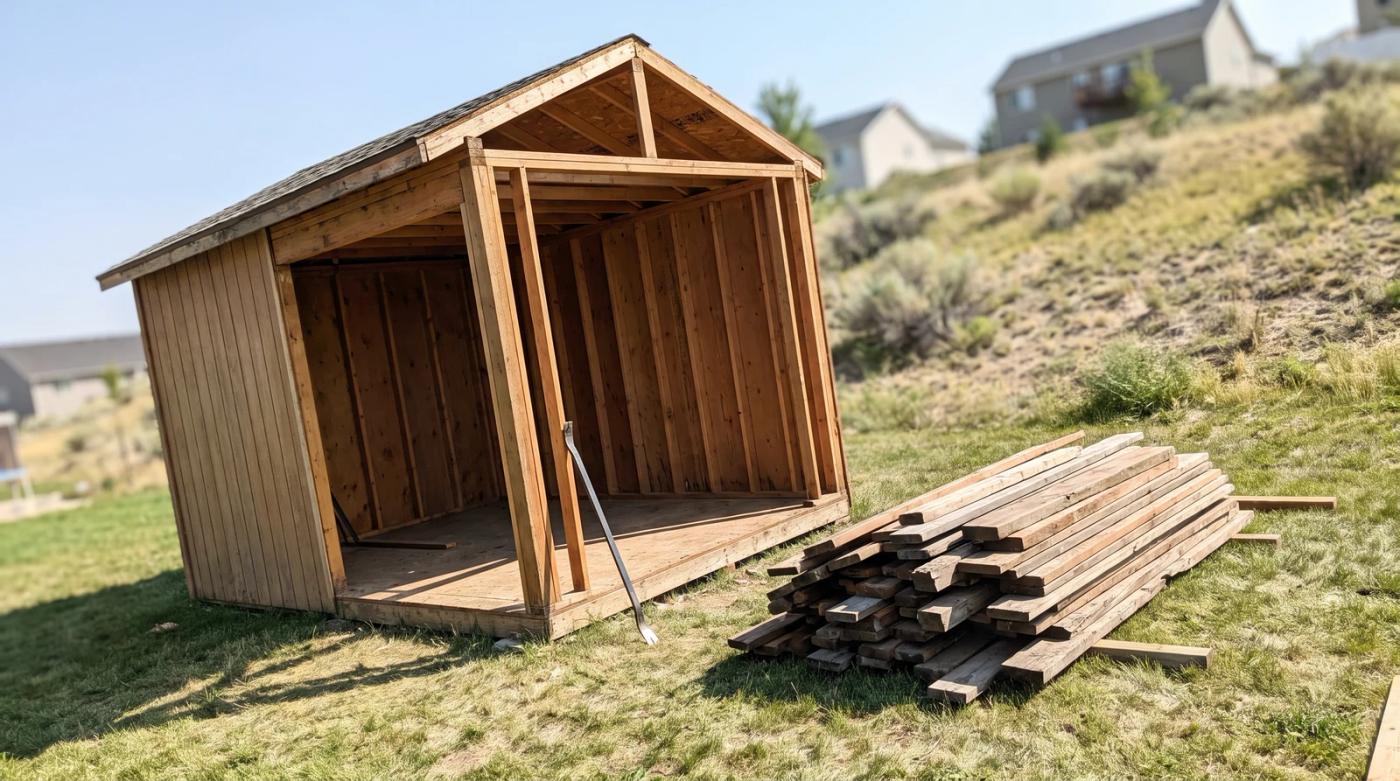
When a shed has given up on life, with one wall bowed out and the roof sagging toward the neighbor's fence, the first question people text me usually isn't the price. It's whether they need a demolition permit in Boise, or anywhere else in the valley, before somebody can knock it down.
Fair question. Nobody wants a letter from the city.
Short answer for most of what I tear out: probably not. But "probably" is carrying a lot of weight in that sentence, and it's worth a quick phone call to know for sure.
When a demolition permit in Boise actually comes into play
Cities care about demolition when the structure was permitted going up, when it's attached to the house, or when utilities run out to it. Take down a whole house, or a detached garage with power run to it, and yes, you're pulling a permit.
Same story if you're removing something structural, or changing the footprint the county has on file.
Small detached stuff is where it loosens up. Most cities around here don't require a building permit for a little accessory structure under a certain square footage. If it never needed a permit to go up, there's usually nothing to close out when it comes down.
The catch is that the square footage number isn't the same everywhere. Boise, Meridian, Eagle, Nampa and Caldwell all run their own building departments, and Ada County and Canyon County set their own rules for addresses outside city limits.
A shed behind a new Middleton subdivision house and a shed on the Boise Bench aren't automatically playing by the same rulebook.
So call. A quick call to the building department for whatever city your mailing address sits in, and they'll tell you straight.
Ask your HOA while you're at it. Those folks sometimes have opinions the city doesn't.
Sheds, decks and hot tubs: where the line usually lands
Hot tubs are the easy one. It's an appliance sitting on a pad, not a structure, and nobody's permitting that.
What you do need is the power killed at the breaker and the wire pulled by somebody who knows what they're looking at. Most tubs out here run on a 240-volt line.
Decks depend on height and attachment. A ground-level deck floating in the backyard is usually a non-event.
A second-story deck bolted to the house is a different animal, because you're opening up the wall where the ledger board was. That ledger board is the part everybody forgets about, right up until there's a row of holes in the siding and rain in the forecast.
Sheds fall wherever the square footage lands. Under the threshold and never permitted, it's just a pile of lumber waiting to happen.
Over that line, or wired for power, make the call first.
Heads up: If the shed or deck went up before the mid-1980s, treat any painted surface as suspect. Don't sand it, grind it, or burn it. Old paint and some old shed roofing carry things you don't want drifting around the yard, and taking the thing apart intact keeps all of that off the table.
What a demolition permit in Boise doesn't cover
The permit is the city's business. Everything underneath the project is still yours.
Digline is free, and calling it before anything goes in the ground is the law. Posts set in concrete, deck footings, anything you're digging out: you call 811 and you wait the required time.
Gas line out to a fire pit, sprinkler mains, low-voltage landscape lighting nobody ever wrote down. It's all out there, and none of it shows up on a plat map.
One clipped irrigation line is plenty to make anybody patient about it.
Then there's disposal, which is the part that surprises people when the number comes back. Demo debris is heavy and bulky, and clean wood, shingles, concrete and metal don't all go to the same place.
Metal gets recycled. The rest generally heads to the transfer station or out to Hidden Hollow, and that dump fee is a real line item, not a rounding error.
That's most of why a teardown costs what it costs across the Treasure Valley. You're not paying for the swinging. You're paying for the loading, the hauling, and the scale ticket at the other end.
What it actually runs
I won't throw a number at you sight unseen. A 10x12 shed on a gravel pad and a 10x12 shed on a poured slab with a concrete apron are two completely different days.
A small shed or a hot tub with easy access sits on the lighter end. A big deck with footings, or a shed where the slab has to come out too, climbs from there. Concrete is usually the expensive part.
Send me a photo and I'll tell you where it lands. And if the honest answer is that you could take it apart yourself with a sawzall over a Saturday and just need the pile gone, I'll say that.
Hauling a pile is cheaper than hauling a pile plus the labor to make it.
Bottom line
Most small demolition around Boise, Meridian and Nampa doesn't need a permit, but a quick call to your city's building department is worth making before anybody starts swinging.
Kill the power, call Digline, and remember that whatever's sitting underneath the thing is what really sets the price.
Got something you want gone? Text a photo to (208) 391-0221 and I'll get you a price. Usually it's out of the yard within a couple of days.
Need help with demolition?
Name and number is all it takes. Man of Steel Junk Removal will get back to you with a price.
Rather just ask?
Skip the reading. Man of Steel Junk Removal picks up the phone.
