
Do You Need a Demolition Permit in Shed Boise Teardowns?
By Tommy Simonson, owner of Man of Steel Junk Removal · Updated
Do you need a demolition permit in shed Boise teardowns? Learn when the city requires one, what to ask first, and what really drives the cost of removal.
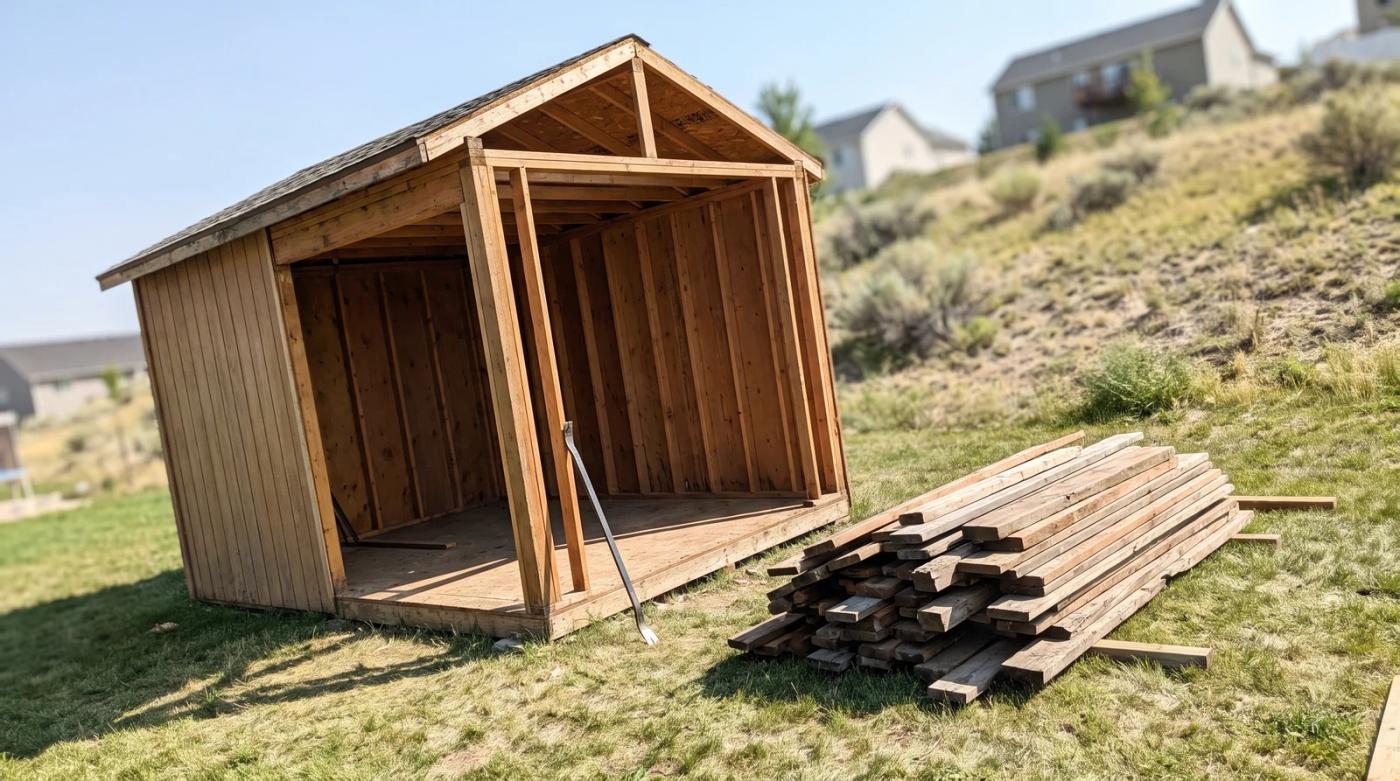
Asking do you need a demolition permit in shed Boise teardowns usually gets a plain no for a small backyard building. That's often true when it has no power and no permit on file. Size, utilities and your city can change that. A quick call before anyone starts swinging is worth it.
Do you need a demolition permit in shed Boise teardowns?
Demolition usually gets the city's attention in a few common cases. The structure was permitted going up, it's attached to the house, or utilities run out to it. Take down a whole house, or a detached garage with power, and yes, the city wants to know.
Same story if you're removing something structural, or changing the footprint the county has on file.
Most construction work in the city goes through permitting of some kind, and tearing things down is no different once a job gets big. That usually means whole houses, garages, anything with utilities and anything attached to the home.
Small detached stuff is where it loosens up. Most cities around here don't require a building permit for a small accessory building under a certain size. If it never needed a permit to go up, there's usually nothing to close out when it comes down.
The catch is that the size cutoff isn't the same everywhere. Each city in the valley, from Meridian and Eagle to Nampa and Caldwell, runs its own building office. Ada County and Canyon County set their own rules for homes outside city limits.
The city wants a building permit for a lot of new structures. So ask whether this one had one going up, because that history can matter as much as its size. Demo paperwork generally runs through the same building department that handles new construction, so one call can cover both questions.
How to check the required permits before you start
Which permit do I need? Bring that question to the city with a few details in hand. Each one below makes the answer quicker.
- Measure the footprint and note whether it sits on a slab, skids or gravel.
- Check whether power, gas or water runs to it. Utilities change the answer more than anything.
- Find out whether a permit was pulled when it went up. The city can often look that up by address.
- Call the building office for the city your address sits in. Tell them what's coming down.
- Ask your HOA too. They sometimes have opinions the city doesn't.
Ask the department to spell out the permit requirements for your address, including any permits required for shutting off and capping gas or electric lines. If Boise requires a demo permit for your project, the permitting side usually wants those utilities handled first.
When permits are required, the city tells you what it needs before work starts. That can mean a permit fee, proof the utilities were shut off and capped, and an inspection once the structure is gone. Ask about the slab and any utility lines too. That's often where the extra paperwork lives.
Good to know: A phone call costs nothing. Sorting things out after the work is done costs a lot more.
Commercial lots are a different story. Most work there goes through permitting, demolition included. Those teardowns usually take more lead time and more paperwork than a homeowner clearing a backyard.
Sheds, decks and hot tubs: building permit requirements by structure
Here's how permit requirements usually shake out for the three things people most often want gone.
| Structure | Permit usually needed? | What changes the answer |
|---|---|---|
| Hot tub | Usually not | Wiring that has to be disconnected |
| Ground-level deck | Usually not | Height and attachment to the house |
| Small outbuilding, no power | Usually not | Size, permit history, zoning setbacks |
| Larger or wired | Often | Utilities, slab, footprint on file |
Hot tubs are the easy one. A tub is an appliance sitting on a pad, not a structure. So a demolition permit usually isn't part of the picture.
What you do need is the power shut off at the breaker. Then the wire should be pulled by someone who knows what they're looking at. A lot of tubs run on a 240-volt line, so that step isn't optional.
Decks depend on height and how they attach. A ground-level deck floating in the backyard is usually a non-event.
A second-story deck bolted to the house is a different animal. You're opening up the wall where the ledger board was. That ledger board is the part everybody forgets about. You find out when there's a row of holes in the siding and rain in the forecast.
Sheds fall wherever the size lands. Under the cutoff and never permitted, it's just a pile of lumber waiting to happen.
Over that line, or wired for power, it usually needs a call first. Planning a new one in the same spot? Ask the department about setbacks now. An old building sitting tight to the fence may not meet the required distance today.
Heads up: If the structure or deck is several decades old, treat any painted surface as suspect. Don't sand it, grind it or burn it. Old paint and some old roofing carry things you don't want drifting around the yard. Taking the thing apart intact helps keep that out of the air.
What a demolition permit in Boise doesn't cover
The building permit is the city's business. Even when permits are required, everything under the ground is still yours.
Digline is free, and calling before you dig is the law. Posts set in concrete, deck footings, anything you're digging out: you call 811 and wait the required time.
Gas line out to a fire pit, sprinkler mains, low-voltage yard lighting nobody wrote down. It's all out there, and none of it shows up on a plat map.
Shutting off and capping those lines is often required before teardown, even when there's no city paperwork.
Then there's disposal, the part that surprises people. Demo debris is heavy and bulky. Clean wood, shingles, concrete and metal don't all go to the same place.
Metal gets recycled. The rest generally heads to the transfer station or out to Hidden Hollow. The charge at the scale is a real line item, not a rounding error.
What moves the cost of a teardown?
That's most of why a teardown costs what it costs across the Treasure Valley. You're not paying for the swinging. You're paying for the loading, the hauling and the scale ticket at the other end.
I won't throw a number at you sight unseen. A 10x12 building on a gravel pad and one on a poured slab with a concrete apron are two very different days.
A few things move the cost up or down:
- Size and weight. More lumber and roofing means more loading and more at the scale.
- Concrete. A slab or footings that have to come out is usually the costly part.
- Access. A building next to a wide gate is easier to clear than one tucked behind a fence and a garden bed.
- Utilities. Power, gas or water that a pro has to shut off and cap adds work first.
- Permitting. If you need a demo permit, the paperwork and any inspections add planning time up front.
- History. A building that needed a permit going up often has wiring or footings that add prep coming down.
Getting any required permits lined up before teardown day keeps the job from stalling halfway through.
A photo is usually enough to tell where it lands. Maybe you could take it apart yourself with a sawzall over a Saturday and just need the pile gone. If that's the honest answer, I'll say so. Hauling a pile costs less than hauling a pile plus the labor to make it.
Bottom line: a lot of small demolition around the valley needs no permit. Kill the power, call Digline, and remember that what's under the thing is what really sets the price.
Got something you want gone? Text a photo to (208) 391-0221 and I'll get you a price.
Frequently asked questions
Do you need a building permit for a 10x12 shed?
A 10x12 is 120 square feet. Whether that's under the building permit cutoff depends on your city, so check before you build or tear one down. The building office can usually tell you over the phone.
Do you need a building permit for a shed in Idaho?
It depends on the city or county, because each one sets its own rules. Small ones with no power often don't need a building permit. Wiring, plumbing or a big footprint usually changes that.
What happens if you don't get a permit for a shed?
If a building permit was required and you skip it, the city can ask you to apply after the fact, make changes, or take it down. It can also come up later when you sell the house.
What happens if you build a structure in your backyard without a permit?
Related reading: Shed Demolition Prep Before Teardown: Boise Guide to Site Cleanup and How to Remove a Wooden Swing Set in Boise, Step by Step.
Related reading: Shed Demolition Prep Before Teardown: Boise Guide to Site Cleanup and How to Remove a Wooden Swing Set in Boise, Step by Step.
Skipping permitting can bring fines or an order to remove it. Any fixes happen on the city's timeline, not yours. Sort it out first by calling and asking: what permit do I need for this exact project?
Need help with demolition?
Name and number is all it takes. Man of Steel Junk Removal will get back to you with a price.
Rather just ask?
Skip the reading. Man of Steel Junk Removal picks up the phone.
